Sensing and
Control Systems
|
TETRIS CALMS ME DOWN
An interactive electronic art piece, displaying technology as not only an extension of our human bodies, but also a reflection of our own identities.
|
|
For this project, I interact with using a Galvanic Skin Sensor, which measures the resistance – an uncontrollable bodily response to stress – in the skin. The resistance is then sent as a serial input to an Arduino micro-controller, which is used to control other output devices connected to the Arduino.
THE MASK
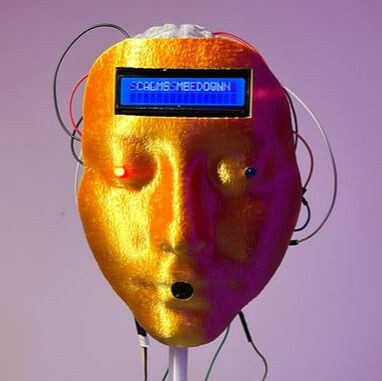
The golden mask is a 3D printed model of my own face, a literal reflection of myself. I used the smartphone app Scandy Pro to scan my face, and the modeling software Rhino3D to edit the scan and prepare for printing. I chose to print the mask in gold filament as an homage to science fiction humanoid characters like C3P0 or those people from Guardians of the Galaxy. I wanted the whole project to have a sort of mysterious, science fiction aesthetic, and I think the color gold works well for this. |

|
THE BRAIN
Since the plan was to model my project after the human body, I wanted to house the Arduino inside a brain. I found a brain model online and used Rhino3D and Fusion360 to edit the brain model for my use. I then 3D printed the model using clear filament. I chose clear filament because I wanted to be able to see the Arduino inside the brain. Unfortunately, filament was not clear enough to see through, but you could still make out the light from the Arduino inside the brain which looks pretty cool.
Since the plan was to model my project after the human body, I wanted to house the Arduino inside a brain. I found a brain model online and used Rhino3D and Fusion360 to edit the brain model for my use. I then 3D printed the model using clear filament. I chose clear filament because I wanted to be able to see the Arduino inside the brain. Unfortunately, filament was not clear enough to see through, but you could still make out the light from the Arduino inside the brain which looks pretty cool.

|
THE GALVANIC SKIN SENSOR For the human input, I used a GSR v1.1 Galvanic Skin Sensor. When the nodes are placed on the fingers, the sensor will produce a number between 0 and ~530. The number produced by these sensors is what I used to control different variables within the output devices. Something I noticed soon after wearing the Galvanic Skin Sensor was that the resistance level read by the sensor very closely matches my own anxiety and stress levels. An example of this is how when listening to certain songs that I associate with comfort or have a happy memory attached to, the resistance value goes down. |
Another example involves an important pastime of mine, Tetris. If I wore the sensors while playing Tetris, I noticed that when I felt more confident about my game and was doing better, the sensor value would also go down. Whereas if I were struggling in that game and very concerned about survival, the sensor value would go up. These observations of stress and anxiety increasing the resistance of my skin influenced the sort of reactions I chose to include in the finished art piece.
|
THE MOTOR As the most important interaction, I used a small dual shaft stepper motor and a TB6600 stepper motor driver. The goal of this interaction was for the face to twitch faster and faster the more anxious I got, simulating my own twitching and fidgeting when put in stressful situations. I did so by inversely mapping the time between motor movements to the resistance value from the Galvanic Skin Sensor. This means that when the resistance value goes up, the time between motor movements decreases, so it appears that the face is looking back and forth very quickly. THE LEDS
For this reaction, I included a red LED and a blue LED within the eyes of the mask. I chose these colors because red is considered to be a very energetic color, while blue is a more calming color. A lower value from the Galvanic Skin sensor would trigger the blue LED to turn on, signifying less anxiety, and a higher value would trigger the red LED to turn on, signifying more anxiety. The two LEDs were never turned on at the same time. |

|
|
THE LCD DISPLAY Another reaction I wanted to include was a display screen on the forehead that changed its message depending on the resistance value from the Galvanic Skin Sensor. Unfortunately, I was unable to figure out how to get the LCD screen to reliably give different phrases. What I was able to do was scroll a single phrase across the screen. With this ability, the final product has the phrase “TETRIS CALMS ME DOWN” scrolling left across the screen. The phrase scrolls faster as the resistance value coming from the Galvanic Skin Sensor increases and scrolls slower as the value decreases. THE BUZZER
The last interaction I included was a Piezo buzzer placed in the mouth of the mask. The tone of the buzzer was mapped to the value from the Galvanic Skin Sensor, so as the value got higher, the tone of the buzzer would also get higher. I attached a resistor to the buzzer, so it wasn’t very loud. I didn’t want the buzzing to be too obvious or overwhelming, but something in the background that slowly becomes more annoying the more you have to listen to it. This represents the human relationship with anxiety, and the way it slowly creeps up on you until you just can’t stand it anymore. |
MOTIVATION AND PURPOSE
While there are many layers to what “Tetris Calms Me Down” represents for me, I was initially inspired by “A Cyborg Manifesto” by Donna Haraway, which in part discussed how any technology created by people is not only an extension of our bodies and our human abilities, but also a reflection of our own identities.
I’m a very anxious person, and when I realized that the Galvanic Skin Sensor was able to pick up on this, I knew I could use this project as an opportunity to extend my invisible and internal anxiety into something external that others could be a part of. The ability for technology to interpret the body and express one’s inner state externally is very powerful in not only helping the individual recognize small biological signals that might otherwise be missed, but also in allowing others to recognize and acknowledge things that often go unsaid – in this case, my own stress and anxiety. People just want to be seen and heard, and technology gives us the autonomy to represent what’s happening on the inside, what’s entirely invisible to the naked eye, visually. We use technology to extend what we know and feel to be true in our hearts, and share that truth with an audience beyond the individual. This is the sort of message I wanted to communicate through my art.
Furthermore, I’d like to discuss the theory of Posthumanism (Hayles, 2010), which views our bodies and minds as ever changing, ever growing, and not confined by any current physical state. This concept drew me in because I've always felt a disconnect from my body that I haven't heard many other people talk about. For me, my body is just the biological machine that keeps my mind and soul alive, and as someone who is mixed race, gender queer, and invisibly disabled, it will never look like how I feel on the inside. For that reason, I often use technology and external artifacts to display myself how I want to be perceived, be that dying my hair or piercing my ears or wearing clothes that send a specific message. And because I know that my body alone will never accurately present my soul without major modifications – modifications I do not want – I may as well present myself as golden faced robot who likes Tetris. Because honestly, sometimes that feels more accurate than blue eyed white girl who stares back at my in the mirror.
|
REFERENCES
|
SCHEMATIC

|
